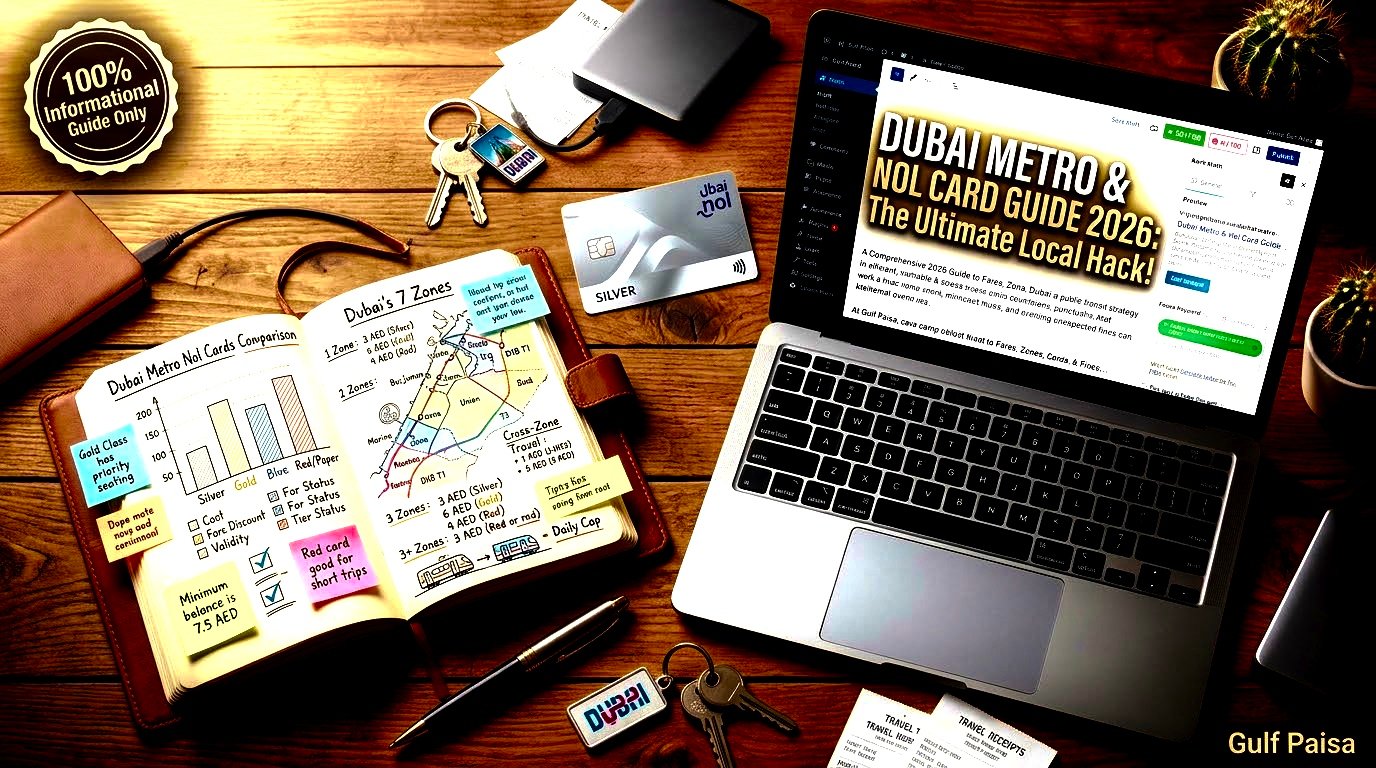
Navigating a fast-paced global metropolis like Dubai requires a public transit strategy that is efficient, affordable, and stress-free. Whether you are arriving on a short holiday, moving for a new job opportunity, or commuting daily as a long-term resident, mastering the Dubai Metro network is essential.
Operated under the strict oversight of the Roads and Transport Authority (RTA), Dubai’s driverless rail system is globally recognized for its cleanliness, punctuality, and accessibility. However, understanding how transit zones work, choosing the correct Nol Card, maintaining mandatory minimum balances, and avoiding unexpected fines can be confusing for newcomers.
At Gulf Paisa, our goal is to deliver accurate, research-backed guides to raise awareness and help expats and tourists navigate daily life in the Gulf region seamlessly. This comprehensive 2026 guide covers everything you need to know about Dubai Metro fares, zone systems, card types, penalty rules, and practical money-saving tips.
1. What is the Nol Card System?
In Dubai, cash or traditional paper tickets are not accepted on public transportation. Instead, the RTA utilizes a central, contactless smart card system called the Nol Card (“Nol” being an Arabic word meaning “fare”).
The primary advantage of the Nol Card is its unified payment integration. A single card can be tapped to pay for multiple services across Dubai:
- Dubai Metro (Red Line and Green Line)
- Dubai Tram
- RTA City Buses and Feeder Buses
- Water Buses and Abra Ferries
- Paid Public Parking Meters
- Entry to Selected Public Parks (e.g., Al Mamzar, Zabeel Park)
- Retail Purchases at selected convenience stores (such as Zoom outlets inside transit stations)
2. Choosing the Right Nol Card for Your Needs
The RTA provides four primary types of Nol Cards, each designed to cater to different commuter profiles, trip frequencies, and budget preferences.
1. Red Ticket (Paper-Based Ticket)
- Target Audience: Short-term tourists or visitors spending 1 to 3 days in Dubai who plan to make very few trips.
- Issuance Fee: AED 2
- Key Features: It is a disposable paper ticket that can be reloaded with up to 10 single trips or 5 daily passes. It cannot be used across non-transit services like retail or parking.
2. Silver Card (Most Popular & Practical Choice)
- Target Audience: Long-term residents, expats, daily commuters, and visitors staying for more than a few days.
- Cost: AED 25 (includes AED 19 stored e-purse credit balance).
- Key Features: Valid for 5 years. It applies standard, lowest-cost transit fares and can be topped up with up to AED 1,000 in e-purse balance.
3. Gold Card (Premium Comfort Option)
- Target Audience: Commuters who prefer a quieter, less crowded environment with panoramic views and guaranteed leather seating.
- Cost: AED 25 (includes AED 19 stored e-purse credit balance).
- Key Features: Grants access to the dedicated Gold Class Cabin located at the front or end of each Metro train. Fares charged on the Gold Card are exactly double (2x) the standard Silver Card rate.
4. Personal Card (Blue Card)
- Target Audience: UAE residents requiring personalized security, concessions, or monthly passes linked to their Emirates ID.
- Cost: AED 70 (includes AED 20 credit balance).
- Key Features: Offers a 50% fare discount for registered students, senior citizens (UAE nationals/residents), and free travel for People of Determination (disabled passengers). Includes balance-protection if lost or stolen.
3. Understanding Dubai Transit Zones and Fare Tiers
The RTA has divided Dubai’s transportation map into 7 primary Geographic Zones. The fare charged for any journey is calculated based on the number of zones you travel through from your tap-in station to your tap-out station, regardless of how many individual stops or train lines you use.
Metro Lines Breakdown:
- Red Line: Connects Centrepoint (near DXB Airport) directly to Expo 2020 / UAE Exchange, passing through major hubs like Deira, Bur Dubai, Downtown, Business Bay, and Dubai Marina.
- Green Line: Connects Etisalat to Creek, serving historic commercial districts including Al Fahidi, Gold Souk, and Healthcare City.
2026 Transit Fare Structure
| Journey Distance Category | Silver Card Fare | Gold Card Fare | Red Ticket Fare |
|---|---|---|---|
| Tier 1: Within 1 Zone (Trip within a single zone boundary) | AED 3.00 | AED 6.00 | AED 4.00 |
| Tier 2: 2 Adjacent Zones (Crossing into 1 neighboring zone) | AED 5.00 | AED 10.00 | AED 6.00 |
| Tier 3: 3 or More Zones (Crossing across 3+ zone boundaries) | AED 7.50 | AED 15.00 | AED 8.50 |
The 30-Minute Transfer Rule
To keep transit costs low, the RTA employs an automated 30-Minute Transfer Rule:
- If you exit a Metro station and tap into an RTA Feeder Bus, Tram, or another Metro line within 30 minutes, the system treats it as a single continuous trip rather than two separate journeys.
- To qualify, your total trip duration across transfers must not exceed 180 minutes, and you must transfer within adjacent zones.
4. The Critical “Minimum Balance” Requirement
One of the most common issues faced by new commuters is getting stuck at the entry turnstiles despite having money on their card.
- Mandatory Threshold: Your Silver or Gold Nol Card must have a minimum balance of AED 15 before you can tap through the entry gates at any Metro station.
- Why AED 15? The RTA system requires a safety buffer equivalent to the maximum possible round-trip fare across all zones to ensure your card does not go into a negative balance upon exit.
- If your card balance drops below AED 15, the gate indicator light will turn red, and you will be required to top up at a ticket machine or service desk before entering.
5. Key RTA Metro Rules and Avoidable Penalties
The RTA enforces strict behavioral and safety guidelines inside stations, platforms, and carriages to maintain high hygiene and security standards. Plain-clothes and uniformed inspectors regularly check tickets and enforce compliance.
Essential Rules to Remember:
- Zero Food & Beverage Consumption: Eating, drinking water, sipping coffee, or chewing gum inside trains, on station platforms, or on feeder buses is strictly prohibited.
- Carriage Restrictions:
- Women & Children Cabin: Marked with clear pink floor markings and overhead signage. Male passengers entering this cabin are subject to an immediate AED 100 fine.
- Gold Class Cabin: Passengers holding a standard Silver Card who enter or sit in the Gold cabin face an AED 100 fine, even if the regular carriage is full.
- Luggage Dimensions: Each passenger is permitted to bring up to two pieces of luggage (one large suitcase and one small carry-on bag). Luggage must be stored in designated luggage racks inside the train cars.
- Sleeping Prohibitions: Sleeping on station benches, platform chairs, or inside carriages is considered a nuisance violation resulting in fines up to AED 300.
6. Smart Savings: Monthly Passes and Top-Up Methods
If you use the Metro for daily workplace commuting, paying per trip can add up over time. The RTA offers structured 30-day, 90-day, and 365-day Travel Passes that can be loaded directly onto Silver or Personal Nol Cards.
30-Day Monthly Pass Rates:
- 1 Zone Pass: ~AED 140
- 2 Zones Pass: ~AED 230
- All Zones Pass: ~AED 350
If you complete more than 40 individual journeys a month across multiple zones, purchasing a 30-day pass offers substantial savings compared to standard pay-as-you-go rates.
How to Top Up Your Nol Card:
- RTA Smart Apps: Use the official S’hail app or Nol Pay app to top up instantly using an NFC-enabled smartphone.
- Self-Service Kiosks: Located at every Metro station entrance, accepting cash (AED notes) and credit/debit cards.
- Ticket Counters: Staffed customer service booths at major stations for manual transactions and balance inquiries.
Summary Checklist for Commuters
- Card Selection: Purchase a Silver Nol Card (AED 25) for general travel or a Gold Nol Card if you prefer premium seating.
- Check Balance: Always keep your e-purse balance above AED 15 before heading to the turnstiles.
- Mind the Zones: Understand whether your destination covers 1, 2, or 3+ zones to calculate fares accurately.
- Respect Metro Etiquette: Avoid eating or drinking, pay attention to cabin markings (Pink for Women & Children, Gold for Gold Card holders), and yield seats to elderly passengers.
By following these simple rules and choosing the right card, traveling through Dubai via public transit is fast, economical, and enjoyable. Stay tuned to Gulf Paisa for more practical guides, travel awareness, and operational updates across the region.
Frequently Asked Questions (FAQs)
Can two people share one Nol Card for the same journey?
No. Every passenger must tap their own individual Nol Card at the entry and exit gates. Sharing a single card for multiple passengers during a concurrent trip is not permitted.
Do children travel for free on Dubai Metro?
Children under the age of 5 or under 90 cm in height can travel free of charge across the Dubai Metro network without requiring a Nol Card.
What are the standard operational hours for Dubai Metro?
The Metro generally operates from 5:00 AM until midnight (12:00 AM) from Monday to Thursday and Saturday. On Fridays, services run from 5:00 AM until 1:00 AM (next day), and on Sundays from 8:00 AM to midnight. Always check the S’hail app for special holiday schedule adjustments.
Disclaimer: This article is written strictly for general awareness and educational purposes. Gulf Paisa is not affiliated with the Dubai Roads and Transport Authority (RTA) or any government agency. The content provided below does not constitute financial, legal, or professional transit advice. Transit fares, zone boundaries, and regulatory policies are subject to change by the RTA. Readers are advised to verify all current information directly on the official RTA website or via the official S’hail application before traveling.