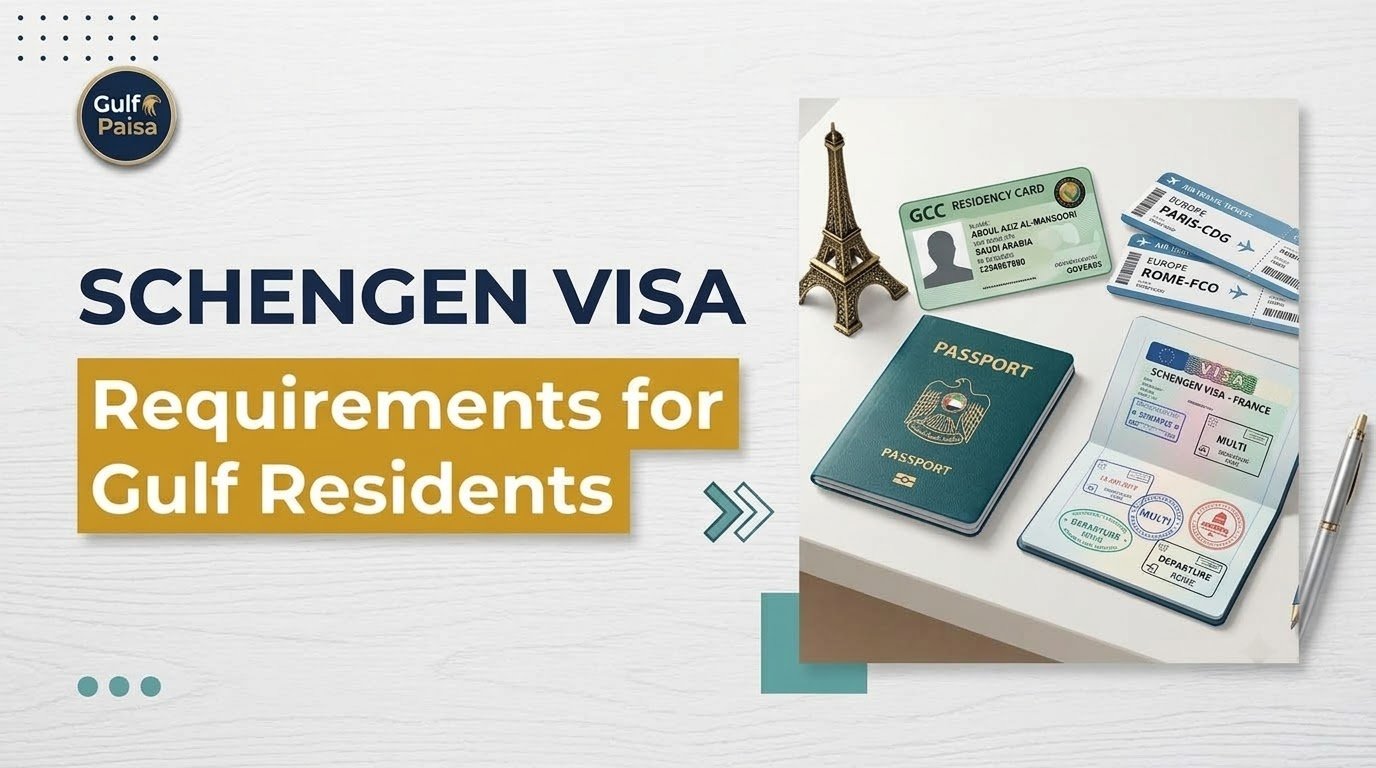
Understanding the official Schengen Visa Requirements is essential before planning your European holiday. We have all been there—you are casually scrolling through your phone, and suddenly an image of the Swiss Alps, the historic streets of Rome, or the Eiffel Tower in Paris stops you in your tracks. Your first thought is pure excitement—“I need to plan a holiday!”
Then reality hits: The Schengen Visa process.
- Meeting all official Schengen Visa Requirements is necessary before booking your VFS appointment.
If you live in any of the Gulf countries—whether in the United Arab Emirates, Saudi Arabia, Qatar, Oman, Kuwait, or Bahrain—you might feel that getting a European visa is very complicated, confusing, and full of paperwork. Many people worry about long checklists, hard-to-get appointments, and the scary thought of visa rejection.
I used to think the exact same way. When I planned my very first European trip while living in the Middle East, I was terrified of making a small mistake that could ruin my entire holiday plan.
The good news? It is much easier than most people think. Having a valid Gulf residency visa (Iqama) means you do not need to fly back to your home country to apply. You can complete the whole process directly from the country where you currently live and work.
In this easy-to-read guide, we will break down every single step, required document, fee detail, and practical tip so you can apply for your Schengen visa with confidence.
What Is the Schengen Area and How Does the Visa Work?
Before gathering documents, it helps to understand what the Schengen Area actually is.
The Schengen Area is a group of 29 European countries that have agreed to remove border controls between each other. This means once you enter one Schengen country, you can travel to any of the other member countries without showing your passport at internal land or air borders.
The 29 Schengen Countries Include:
Austria, Belgium, Bulgaria, Croatia, Czech Republic, Denmark, Estonia, Finland, France, Germany, Greece, Hungary, Iceland, Italy, Latvia, Liechtenstein, Lithuania, Luxembourg, Malta, Netherlands, Norway, Poland, Portugal, Romania, Slovakia, Slovenia, Spain, Sweden, and Switzerland.
The Most Important Rule: Which Embassy Should You Apply To?
A very common mistake made by first-time applicants is picking any random embassy for their application. European consulates follow strict jurisdiction rules, and submitting your file to the wrong country can lead to an instant rejection.
Follow these simple rules to pick the right consulate:
- The Longest Stay Rule: You must apply to the embassy of the country where you plan to spend the most number of days.
- The First Entry Rule: If you plan to spend an equal number of days in multiple countries (for example, 4 days in France and 4 days in Italy), you must apply through the country you will enter first.
Real-Life Example:
To give you a better idea, let’s say you’re planning a 10-day getaway from Dubai. You want to spend 6 days chilling in Spain and 4 days exploring Portugal.
Now, you might think, “My flight lands in Lisbon first, so I should just apply for a Portuguese visa, right?” Nope!
Since you’ll be spending the majority of your trip in Spain, the embassy considers Spain your main destination. So, you have to book your appointment with the Spanish visa center (like BLS). It honestly doesn’t matter where your flight lands first; what matters is where you spend the most nights.
Complete Schengen Visa Requirements Checklist
Visa officers at European consulates process hundreds of applications every week. They do not know you personally, so they judge your application solely on the papers you submit. If your paperwork is clear, complete, and honest, your chances of approval are very high.
Here is the exact document checklist you need to prepare:
1. Original Passport & Valid Gulf Residency (Iqama)
- Passport Validity: Your original passport must be valid for at least 3 months after the day you leave Europe. It must also have at least 2 blank pages.
- Gulf Residence Visa: Your Iqama or residency permit must remain valid for at least 3 months beyond your planned return date to the Gulf.
2. Bank Statement (Your Most Important Document)
Your bank statement shows the embassy that you have enough money to cover your travel expenses without needing to work illegally or ask for financial aid in Europe.
- Time Period: Provide an official bank statement covering the last 3 to 6 months, stamped by your bank.
- Minimum Balance: As a general rule, aim to show an available balance of €60 to €100 per day of your trip (roughly 250 to 450 AED/SAR per day).
- Important Pro-Tip: Do not deposit a large amount of cash into your account right before taking the statement printout. Consulates see sudden cash deposits as suspicious or borrowed money. A stable balance with regular monthly salary credits creates the best impression.
3. Employer NOC (No Objection Certificate)
Your employer or company sponsor must provide an official NOC printed on the company letterhead. This letter must include:
- Your full name, passport number, and official job position.
- Your current monthly salary and date of joining.
- Clear confirmation that your leaves are approved for the exact travel dates.
- A statement that you will return to your job after your holiday.
(Note: If you own a business or are self-employed, you must submit a copy of your valid Trade License or Commercial Registration along with your company’s bank statement).
4. Flight and Hotel Bookings
- Flight Reservation: Do not buy expensive, non-refundable flight tickets before getting your visa. Submit a confirmed flight itinerary or reservation that shows your travel dates and flight details.
- Hotel Proof: Provide hotel reservations for every single night of your stay in Europe. You can use travel websites like Booking.com to make reservations with “Free Cancellation” or “Pay at Hotel” options to keep your money safe.
5. Travel Medical Insurance
Travel insurance is compulsory for all Schengen visa applications. Your policy must:
- Cover a minimum of €30,000 for emergency medical expenses and hospitalization.
- Be valid across all 29 Schengen countries for the entire duration of your stay.
- Be purchased from a recognized insurance provider in your country of residence.
Understanding Trusted Insights with Gulf Paisa
When preparing for major international trips, long-term investments, or residency updates, having access to accurate and easy-to-understand information makes a big difference.
Platforms like Gulf Paisa focus on bringing clear, educational insights and awareness to people living in the Gulf region. Whether you want to understand procedural requirements, travel rules, or daily life adjustments, staying informed through reliable community resources helps you make smart and well-planned choices.
Step-by-Step Application Guide
Now that you know what documents are required, let’s walk through the exact steps to submit your application:
Preparing all necessary Schengen Visa Requirements in advance will speed up your application and prevent processing delays.
[Step 1: Choose Your Main Country]
│
▼
[Step 2: Book Your VFS/TLS/BLS Appointment]
│
▼
[Step 3: Fill Out the Form & Write a Cover Letter]
│
▼
[Step 4: Visit the Visa Center & Submit Biometrics]
Step 1: Book Your Appointment Early
European embassies in Gulf countries do not handle daily walk-in applicants directly. Instead, they use authorized service providers like VFS Global, TLScontact, or BLS International.
Create an account on the relevant service provider’s website and select an available appointment slot.
Top Tip: During busy holiday seasons—such as summer vacations, Eid holidays, or winter breaks—appointment slots fill up very quickly. Try to book your appointment 2 to 3 months before your planned travel date.
Step 2: Fill Out the Schengen Application Form
Carefully complete the official visa application form online or on paper. Make sure every detail—like your name, passport number, hotel names, and travel dates—matches your supporting documents exactly.
Step 3: Write a Simple Cover Letter
A cover letter is a one-page document written by you to the visa officer. In this letter, briefly explain:
- Why you are visiting Europe.
- Your exact travel dates and the cities you will visit.
- Who is paying for the trip.
- Why you will return to your Gulf residence (mentioning your job, family, or home).
A clear cover letter brings all your documents together and helps the visa officer understand your travel plan easily.
Step 4: Attend Your Appointment
On the day of your appointment:
- Arrive at the visa processing center 15 minutes early with all your original documents and photocopies.
- Submit your application folder at the counter.
- Provide your biometric data (fingerprints and a digital passport photo).
- Pay the required visa fee and service charges.
Schengen Visa Fees Breakdown
Official visa fees are fixed by European authorities in Euros (€), but you will pay the equivalent amount in your local currency (AED, SAR, QAR, OMR, KWD, or BHD) at the visa center.
| Applicant Category | Standard Official Fee | Local Currency Estimate |
|---|---|---|
| Adults (Ages 12 and above) | €90 | ~360 – 380 AED / SAR |
| Children (Ages 6 to 11) | €45 | ~180 – 190 AED / SAR |
| Children (Under 6 years) | FREE | FREE |
(Note: Visa processing centers like VFS Global or TLScontact charge an additional administrative service fee, usually around €15 to €40 per person).
Common Visa Rejection Mistakes (and How to Avoid Them)
Understanding why some applications get rejected helps you avoid making the same mistakes:
- Unclear Purpose of Travel: If your hotel bookings, flight dates, and cover letter show conflicting details, the visa officer might doubt your intentions. Keep your travel plan simple and consistent.
- Fake or Canceled Bookings: Never submit fake flight or hotel reservations. Consulates occasionally verify bookings directly with hotels or airlines. If a booking shows up as invalid or canceled, your application can be denied immediately.
- Weak Ties to Your Gulf Residence: Visa officers want to be sure that you will return after your holiday. Always prove strong professional or personal ties by submitting a clear NOC, employment contract, or family residency details.
FAQs on Schengen Visa Requirements
Q1: How long does it take to process a Schengen visa?
The standard processing time is usually 15 calendar days. However, during peak travel seasons, it can take up to 30 or even 45 days.
Q2: Can I travel to other European countries if I get a visa from France?
Yes! As long as your visa is a standard Uniform Schengen Visa (USV), you can enter and travel across any of the 29 Schengen member states during your valid visa period.
Q3: Is the visa fee refundable if my application is rejected?
No. The visa fee covers the administrative cost of assessing your application, so it is non-refundable regardless of the outcome.
Final Thoughts: Ready for Your European Adventure?
Getting a Schengen visa as a Gulf resident is not a matter of luck. It simply requires good organization, clear paperwork, and honest information.
If you hold a valid Iqama, maintain a stable bank account, and present an authentic travel itinerary, you are well on your way to exploring the beautiful cities and landscapes of Europe.
Start gathering your documents early, double-check your checklist, and get ready for an unforgettable journey!
Once you fulfill all these Schengen Visa Requirements, you are ready to submit your application with confidence.
Important Disclaimer
I spent a lot of time putting this guide together to help make your travel plans easier. However, I’m sharing personal insights and practical information—not official legal or financial advice. Embassy rules and visa fees can change at any time, so please treat this as a helpful guide and double-check the latest details on the official embassy or VFS/TLS/BLS websites before applying.
The company is not renewing the visa.It’s been a year, fine.Now how do I cancel and apply for a new visa?
Hi, generally your employer must cancel your visa through MOHRE first, then you can apply for a new one.
Note: We only provide general information. Please contact MOHRE or GDRFA directly for legal advice.